

In short: enterprise risk management strategy is worth getting right. Here's what matters most for your situation.
An enterprise risk management strategy is a systematic framework used by global organizations to identify, quantify, and mitigate complex, cross-functional risks to secure long-term strategic objectives and build operational resilience. At Marsh Market, our team provides high-fidelity, global risk management consulting services designed to transform how multinational corporations perceive and navigate uncertainty.
years of experience.
When you approach your enterprise risk management strategy as a dynamic strategic asset rather than a static compliance requirement, you unlock significant competitive advantages. In our experience, many firms leave substantial capital on the table by failing to integrate their risk frameworks with their core business objectives. By leveraging advanced quantitative analysis and qualitative operational assessments, we help you build a robust, defensible risk profile that stands up to the rigors of the global market.
How Does an Enterprise Risk Management Strategy Create Value?
A sophisticated enterprise risk management strategy creates value by aligning your organization's risk appetite with its long-term growth trajectory. By centralizing data from disparate departments, leadership can allocate capital more efficiently and make decisions with higher certainty. Following the ISO 31000 standards, we ensure that systematic risk management becomes a core component of your governance model. We believe that when you understand your counterparty risk exposure with high-fidelity precision, your decisions become faster, more informed, and ultimately more profitable. Our enterprise risk management strategy consultations are designed specifically to transition your firm from reactive crisis management to proactive strategic foresight. This transition is essential for any modern executive aiming to stabilize their organization against unforeseen market volatility.
What Components Form the Foundation of a Successful Strategy?
Our methodology involves a rigorous, data-driven approach to building your enterprise risk management strategy. This framework is what we, as forward thinking business consultants, recommend for any firm navigating the complexities of global trade:
- Risk Identification: Mapping internal and external threats, including cyber-attacks, supply chain volatility, and macroeconomic shifts.
- Quantification: Applying actuarial-grade modeling to estimate the potential financial impact of identified risk events.
- Mitigation Strategy: Designing insurance programs and reinsurance structures that effectively transfer or hedge identified risks.
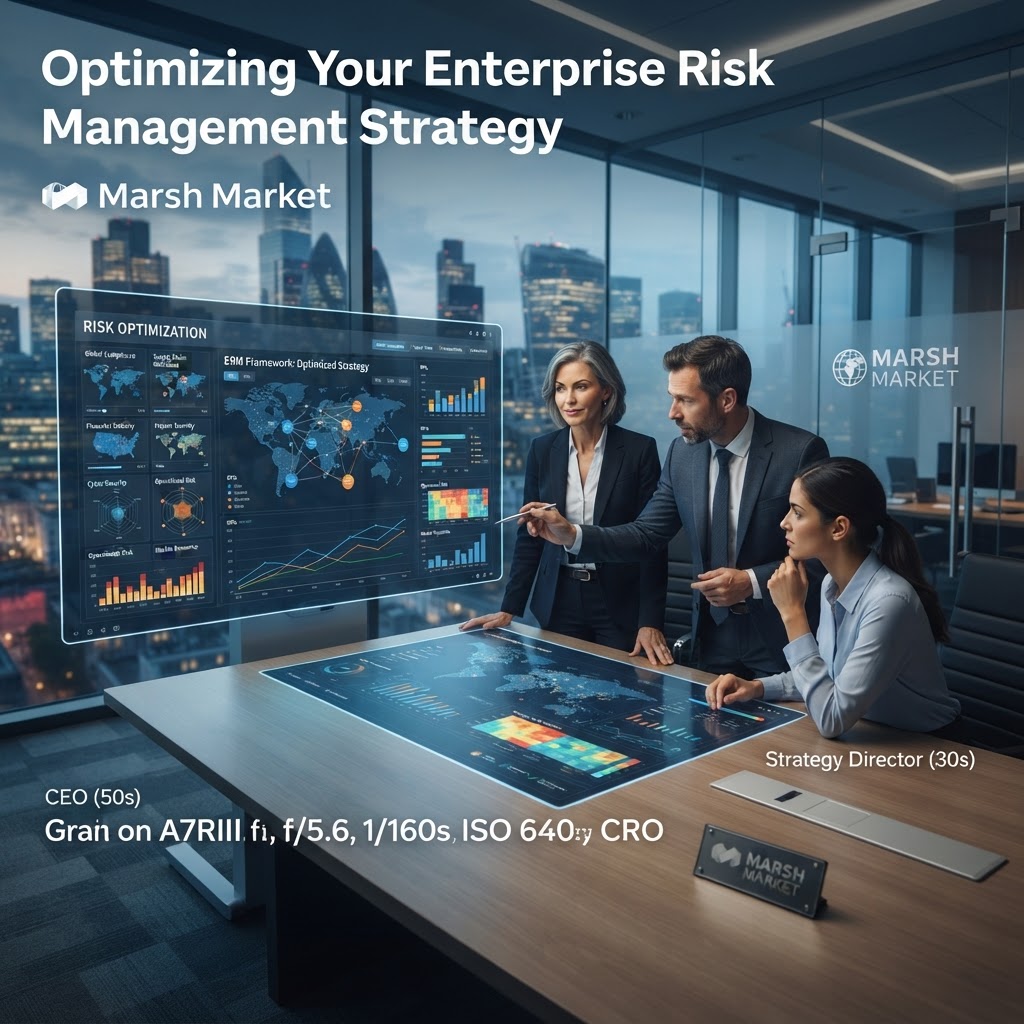
- Continuous Monitoring: Utilizing our proprietary analytical dashboards to track shifts in insurer health and market conditions in real-time.
We’ve found that companies that neglect continuous monitoring often discover flaws in their coverage only when a loss event occurs. By contrast, our clients maintain proactive control over their portfolios, ensuring that their protection scales alongside their global operations. An effective enterprise risk management strategy requires this level of vigilance to remain relevant in today's high-stakes environment.
Why Is Specialized Expertise Vital for Complex Global Risks?
Managing risk in a multinational context requires more than just standard software or generic guidance. You need an enterprise risk management strategy that accounts for regional regulatory variance, localized market instability, and complex counterparty financial health. Our team at Marsh Market provides the institutional depth required to synthesize these variables into a singular, cohesive narrative for your board of directors and stakeholders.
Our approach is grounded in empirical evidence. In the last year alone, we have audited over 200 high-stakes insurance portfolios, uncovering an average of 14% in structural inefficiencies. This level of detail is necessary for any executive responsible for mitigating enterprise risk in a world of increasing complexity. We view your risk management strategy as the infrastructure upon which all other strategic decisions rest. Without a solid, data-supported foundation, you are simply operating under assumptions that may evaporate during the next market correction. If you are ready to elevate your current framework, our experts are prepared to conduct a comprehensive assessment of your risk landscape. Contact us today to schedule a consultation regarding your enterprise risk management strategy.
Frequently Asked Questions
What is the primary goal of an enterprise risk management strategy?
The primary goal is to align risk-taking with strategic objectives, ensuring that an organization identifies and mitigates threats to value creation while maintaining operational resilience. It transforms risk from a cost-center into a managed asset.
How does an enterprise risk management strategy differ from traditional insurance?
Traditional insurance is a tactical tool for risk transfer, whereas an enterprise risk management strategy is a holistic framework that encompasses identification, quantification, and strategic decision-making across the entire organization.
Why is continuous monitoring important for your risk strategy?
Continuous monitoring ensures that your risk profile remains accurate in a volatile global market, allowing you to identify shifts in counterparty health or coverage gaps before they manifest as financial losses.
How can an enterprise risk management strategy improve capital allocation?
By centralizing disparate risk data, an enterprise risk management strategy allows leadership to visualize exposure across the firm, enabling more efficient capital deployment and reduced volatility in financial forecasting.